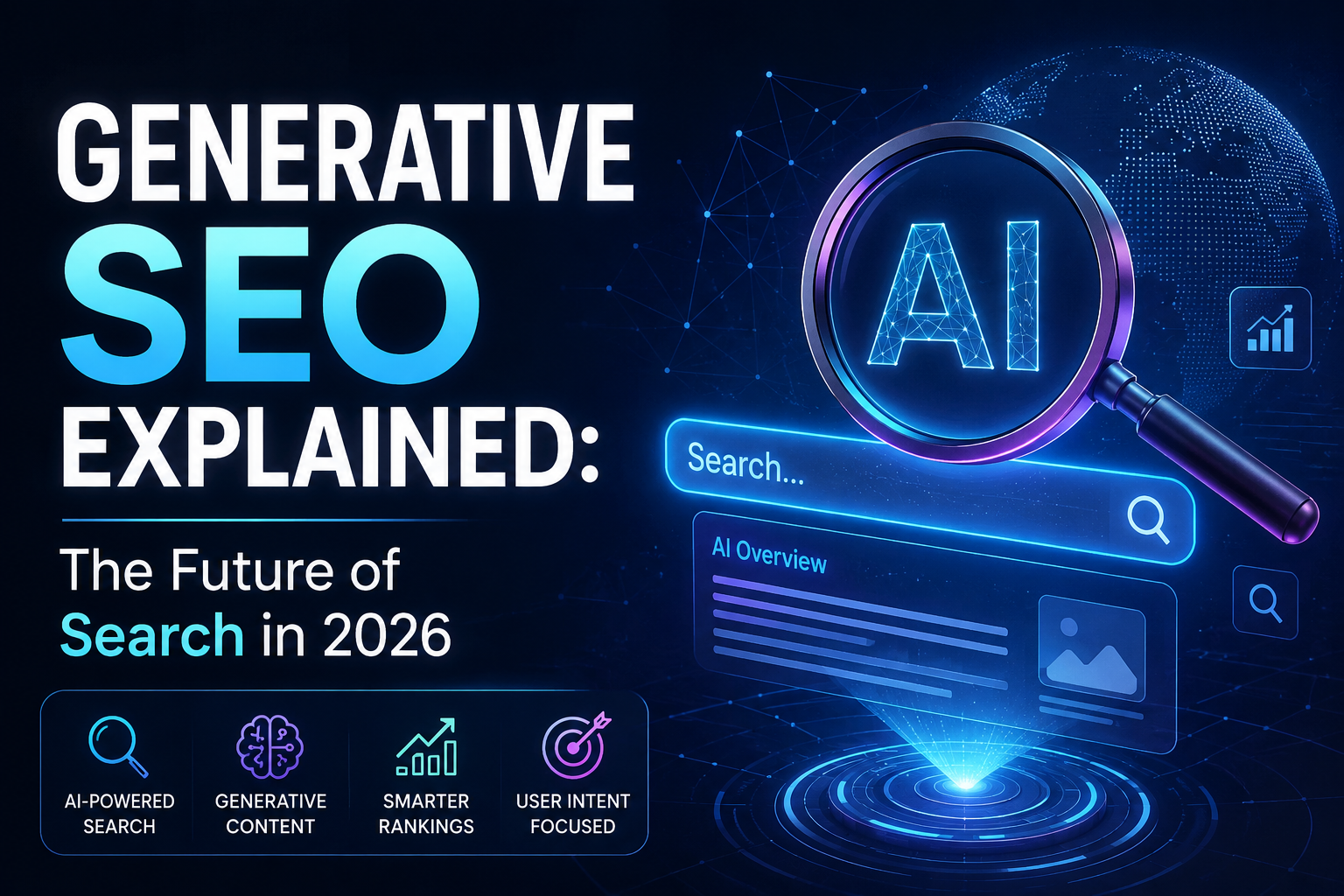
Search is no longer about ten blue links. In 2026, AI-generated answers have become the new first page and if your content isn’t optimised for generative engines, you’re invisible. This guide breaks down everything you need to know about Generative SEO: what it is, why it matters, and exactly how to win at it.
1. What Is Generative SEO?
Generative SEO is the practice of optimising your content, website structure, and digital presence so that AI-powered search engines and language models will cite, reference, and surface your content within their generated responses.
Unlike traditional SEO, where the goal was to appear in the top 10 ranked links, Generative SEO targets the AI’s answer itself the paragraph, the summary, the recommended source. If you’ve ever asked ChatGPT, Google’s AI Overview, or Perplexity a question and seen a website mentioned in the response, that’s Generative SEO at work.
2. Understanding SGE & AI Overviews
Google’s Search Generative Experience (SGE), now rebranded and deeply integrated as AI Overviews, has fundamentally changed how search results look. Instead of a list of links at the top, users now see a full AI-generated answer with a handful of source citations below it.
By mid-2026, Google’s AI Overviews appear on the majority of informational and commercial queries. This means the traditional ‘Position 1’ result may actually sit below the fold, after the AI Overview box has already answered the query.
| 63% of Google searches now trigger an AI Overview (2026 est.) | 42% drop in click-through rates on ‘zero-click’ AI queries | 3–5 sources typically cited per AI Overview response | 7x more traffic to sites cited as AI sources vs. position 5 |
3. Why Generative SEO Matters More Than Ever in 2026
The search landscape has experienced three massive shifts at once:
The Rise of Answer Engines
Tools like Perplexity AI, ChatGPT Search, Microsoft Copilot, and Google’s AI Overviews are all competing to answer your query directly not just link to a page that might. Hundreds of millions of people now use these tools daily instead of traditional search.
Declining Organic Click-Through Rates
When users get the answer directly in the search result, they don’t need to click. This means websites that relied purely on organic traffic are seeing significant drops — unless they adapt to become a source within AI answers.
Brand Authority Signals Are Amplified
AI models favour brands and websites they ‘trust’ those with strong E-E-A-T (Experience, Expertise, Authoritativeness, Trustworthiness), consistent publishing, and reputable backlinks. This makes authority-building more important than ever.
4. Traditional SEO vs. Generative SEO: Key Differences
| Factor | Traditional SEO | Generative SEO |
| Goal | Rank #1 in link results | Be cited in AI-generated answers |
| Content Format | Keyword-stuffed long pages | Clear, structured, authoritative answers |
| Success Metric | SERP position, CTR | AI citation rate, brand mentions |
| Keywords | Exact match focus | Semantic topics & conversational intent |
| Backlinks | Volume-based link building | Quality citations from authoritative sources |
| Content Strategy | Volume-driven publishing | Depth, accuracy, unique perspective |
| Technical Focus | Page speed, meta tags | Structured data, schema markup, entity clarity |
5. How Generative AI Search Actually Works
Understanding how AI search engines work is the first step to optimising for them. Here’s a simplified breakdown:
- Query Understanding — The AI interprets the user’s intent — not just the words, but the full context, follow-up questions, and conversational history.
- Source Retrieval — The model retrieves relevant documents from its index or live web. It prefers sources that are well-structured, authoritative, and frequently cited.
- Answer Synthesis — The AI synthesises information from multiple sources into a single, coherent response — citing sources when appropriate.
- Source Attribution — Trusted, credible sources are highlighted as references. These are the sites that benefit most from Generative SEO.
6. 7 Generative SEO Strategies to Rank in AI Search
Here are the most effective tactics working in 2026 to get your content cited by AI systems:
1. Build Topical Authority, Not Just Pages
Instead of targeting isolated keywords, build content clusters a comprehensive hub page supported by multiple supporting articles. AI search engines reward websites that demonstrate mastery of a subject area, not just one keyword.
2. Use Structured Data (Schema Markup)
Implement schema markup for your articles, FAQs, how-to guides, reviews, and products. Use FAQPage, HowTo, and Article schema on every relevant post. Validate with Google’s Rich Results Test after implementation.
3. Write for Semantic Intent, Not Just Keywords
Think about the full question your reader is asking, not just the keyword phrase. Use natural language, address the ‘who, what, why, how’ — conversational, intent-driven content performs far better in AI search.
4. Strengthen Your E-E-A-T Signals
AI models heavily weight Experience, Expertise, Authoritativeness, and Trustworthiness. Author bios with real credentials, ‘About’ pages, editorial policies, original research references, and a consistent publishing history all matter enormously.
5. Get Cited by Authoritative Sources
If reputable publications, industry sites, and directories mention or link to your website, AI models pick up on those trust signals. Digital PR, guest contributions, and niche directory listings all help here.
6. Optimise Content Structure for ‘Extractability’
Use clear headings (H2, H3), short paragraphs, bullet points, definition-style answers, and summary boxes. AI models scan for directly usable answer fragments the easier you make it, the more likely you’ll be cited.
7. Update Content Regularly
AI search systems prefer fresh, updated content. Schedule regular content audits and update your top-performing posts with new data, examples, and current information.
7. Optimising for Answer Engines: Perplexity, ChatGPT & More
In 2026, millions of users get their information from Perplexity AI, ChatGPT Search, Microsoft Copilot, and emerging AI assistants. Each has its own indexing and citation preferences.
Perplexity AI
Perplexity crawls the live web and heavily cites sources. It favours authoritative domain names, clear factual content, and pages with schema markup. Appearing on Perplexity’s citation list can drive significant referral traffic.
ChatGPT Search
ChatGPT’s search integration (via Bing and its own crawlers) surfaces well-structured, trustworthy pages. Ensure your site is Bing-indexed, has clear entity structure, and content directly answers conversational questions.
Google AI Overviews
Google remains the dominant player. AI Overviews pull from Google’s index, so traditional SEO foundations still matter but structured data, E-E-A-T, and topical authority now play an amplified role.
8. What Kind of Content Does Generative AI Prefer?
Based on patterns in 2025–2026, AI systems tend to prefer:
- Definitional content — clear, concise explanations of ‘what is X’
- How-to guides — step-by-step instructions with structured formatting
- Comparison articles — ‘X vs. Y’ with structured data
- Statistics and data — original research or curated data with proper sourcing
- Expert opinions — attributed to real people with verifiable credentials
- FAQ sections — directly addressing common questions in Q&A format
9. Common Generative SEO Mistakes to Avoid
Many SEOs are still only optimising for Google. But your audience may increasingly use Perplexity or ChatGPT Search — make sure your content is indexable and structured for all major AI platforms.
Treating All Content as Equal
Not every blog post needs the full Generative SEO treatment. Focus your deepest efforts on high-intent, high-value pages — those targeting queries that AI systems are most likely to generate answers for.
Neglecting Technical Foundations
Generative SEO doesn’t replace technical SEO — it adds to it. Slow sites, broken pages, poor mobile experience, and missing schema will still undermine all your content efforts.
Publishing Without Author Authority
Anonymous or unattributed content loses trust in the AI era. Every important piece of content should have a named, credentialled author with a linked bio.
10. The Future: Where Is Search Headed?
Multimodal search is expanding — AI will increasingly process images, audio, and video alongside text. Optimising your visual content with proper alt text, descriptive filenames, and video transcripts will become a new frontier.
Personalised AI answers will grow — search results will be increasingly tailored to the individual user’s history, preferences, and context. Brand recognition and consistent messaging across platforms will matter more.
AI agents are emerging — rather than searching for information, users will delegate tasks to AI agents that make decisions on their behalf. Being a trusted, well-known brand becomes your greatest SEO asset.
The bottom line? Generative SEO is not a trend — it’s the new baseline. The brands that understand and adapt to it today will own the search landscape of tomorrow.
Final Thoughts
Generative SEO is transforming the way people discover information online. As AI-powered search engines and conversational assistants become more sophisticated, success is no longer measured solely by traditional search rankings. Instead, brands must focus on creating accurate, authoritative, and context-rich content that AI systems can understand, trust, and reference.
The future of search in 2026 is conversational, personalized, and driven by generative AI. Businesses that adapt their SEO strategies today by prioritizing user intent, expertise, and content quality will be better positioned to gain visibility in AI-generated search experiences.
Generative SEO is not replacing traditional SEO—it is evolving it. By embracing this shift now, your website can stay competitive and become a trusted source in the next generation of search.
For more insights on SEO, Digital Marketing, Business, Technology, AI Trends, and the future of search, follow The Digital Fact.